From Layers to Slices
How we moved a layered .NET 7 API to vertical slices, with an AI pair that works inside written rules, automated checks and human decisions."
The File Nobody Wanted to Open
Every old codebase has one file people quietly avoid. In this one, it's 11,922 lines long. Everybody just calls it "the controller."
Scroll down to around line 563 and you land on the exact moment a customer hands over money for a car. In the code, it looks almost embarrassed about what it's doing (names simplified here):
[HttpPost("allocate")]
public IActionResult Allocate([FromBody] Transaction obj)
{
    long result = 0;
    long rows_effected = 0;
    if (obj != null)
    {
        decimal amt = Convert.ToDecimal(obj.amount);
        obj.is_removed = 0;
        using (TransactionData _data = new TransactionData(configuration))
        {
            result = _data.InsertAllocation(obj, amt);
            rows_effected = rows_effected + result;
        }
    }
    return CreatedAtRoute(new { ID = rows_effected }, rows_effected);
}
Read it twice. Notice what's missing.
Nobody asks whether this receipt actually belongs to this customer. Nobody checks whether there's money left on it. Nobody checks whether the order it's going toward is already paid in full. Maybe the stored procedure behind InsertAllocation asks those questions — but its text lives somewhere outside the repository, which means the honest answer to "where are the rules for this?" is: we don't know. Go and look somewhere else.
Go and look somewhere else. Say that phrase enough times across enough files, and you've just described the entire personality of a codebase. It's the reason we spent the last two weeks taking this one apart.
Why a Tidy Diagram Turns Into This
Nobody sat down and designed it to be confusing. Nobody ever does.
The system runs the back office of a vehicle-export business — stock, price inquiries, orders, invoices, customer receipts, shipping bookings, and the emails that stitch all of it together. It started life as a single ASP.NET Core 7 project, built the way the textbooks still teach it: controllers on top, a business layer underneath holding the rules, data access at the bottom. Three clean floors.
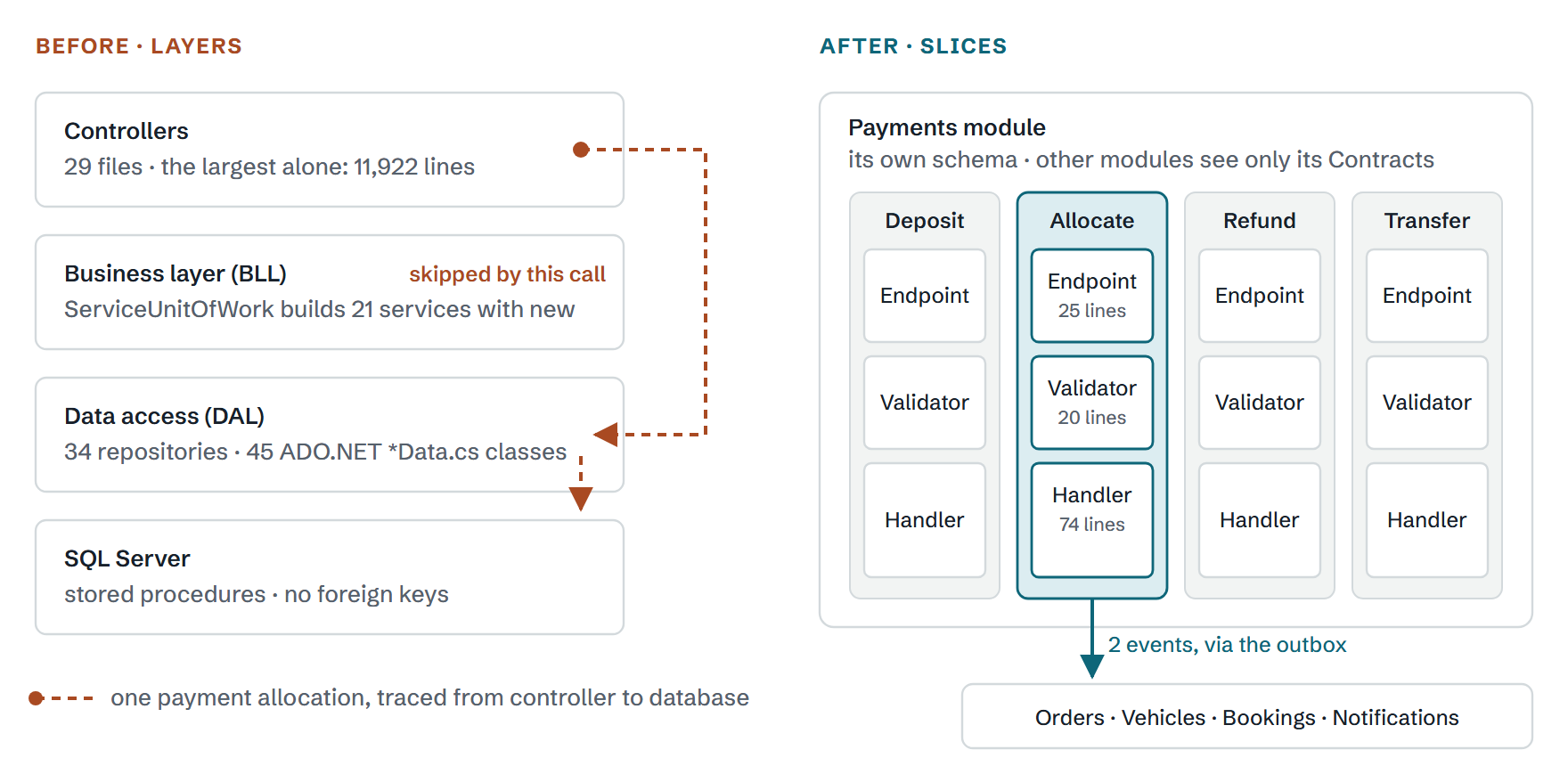
On paper, tidy. In practice, it felt like a house where the stairs had been moved a few times without telling anyone. Twenty-nine controller files add up to roughly 24,700 lines. A class called ServiceUnitOfWork hand-builds 21 services with new. A matching UnitOfWork hand-builds 34 repositories. And underneath all of that, three separate roads lead to the same database — EF Core, raw SQL run through EF, and 45 older ADO.NET classes calling stored procedures directly. The payment allocation above takes the shortest of those roads: straight from the controller into a data class, the business layer never even in the room.
Is that really so different from any growing system? Not really — and that's the point. A deadline shows up. The shortest path from a button to a database table wins. The layer that was supposed to hold the rules gets quietly walked around, just this once. Do that often enough, for long enough, and one feature becomes a thread running through every floor of the house. Pull on it, and you end up opening every door in the building.
Stop Organizing by Floor. Start Organizing by Question.
Here's the question that changed everything: instead of asking which layer does this code belong to, what if you asked what is the user actually trying to do, right now?
Each answer gets its own folder. Nothing more complicated than that. That's the whole idea behind what's called a vertical slice — and it's what the new backend is built around: a modular monolith on an open-source .NET 10 starter kit, still running on SQL Server.
Here's what that looks like once it stops being a diagram and becomes actual code. Allocating a payment now lives in exactly one place: Payments/Features/v1/CustomerPayments/AllocateCustomerPayment/. Open that folder and you'll find three files, 119 lines total: an endpoint that answers POST /customer-payments/{id}/allocate, a validator, and a handler. That's it. The command itself sits in a small Contracts project — the only door other modules are allowed to knock on. Nobody reaches in and grabs Payments' internals directly, ever.
Read the handler start to finish and the rules are simply there, in order, like a short checklist taped to the wall: the receipt has to already be deposited to a customer, and it needs a currency. The amount can't be more than what's left on the receipt. The order it's going toward can't already be paid past its proforma invoice total. Clear all four, and the handler posts a PUR line to the ledger and raises two events — one tells Orders, Vehicles and Bookings a payment changed, the other tells Notifications to email the customer. Both land in a transactional outbox, saved in the same breath as the ledger line, delivered roughly ten seconds later.
Read the handler
var payment = await dbContext.CustomerPayments
    .FirstOrDefaultAsync(e => e.Id == command.CustomerPaymentId, cancellationToken)
    ?? throw new NotFoundException($"CustomerPayment {command.CustomerPaymentId} not found.");

if (payment.CustomerId is not { } owner
    || payment.Status is not (CustomerPaymentStatus.AvailableDeposit or CustomerPaymentStatus.AssignmentOk))
    throw ReceiptRules.Conflict("The receipt is not deposited to a customer.");

if (payment.Currency is not { } currency)
    throw ReceiptRules.Conflict("The receipt has no currency.");

if (command.Amount > payment.Remaining)
    throw ReceiptRules.Conflict($"The amount is more than the receipt's unallocated rest ({payment.Remaining}).");

var order = await OrderPaymentRules.GetOrderWithVehicleAsync(mediator, command.OrderId, command.VehicleId, cancellationToken);
OrderPaymentRules.EnsureValid(order);
if (command.Amount > 0 && order.PaidTotal > order.Amounts.JpPiTotal)
    throw ReceiptRules.Conflict($"The order is already paid more than its PI total ({order.PaidTotal} of {order.Amounts.JpPiTotal}).");

payment.Allocate(command.Amount, command.OrderId, command.VehicleId);
LedgerEntry purchase = await ledger.PostAsync(AccTransactionTypeCodes.Purchase, owner, command.Amount, currency, payment.Id, /* … */);

events.OrderPaymentChanged(command.OrderId, command.VehicleId, OrderPaymentChange.Allocated, command.Amount, /* … */);
events.PaymentAllocated(purchase.Id, payment.Id, owner, command.OrderId, command.VehicleId, command.Amount, currency, /* … */);

await ReceiptRules.SaveAsync(dbContext, cancellationToken);
return purchase.Id;
ConfigureAwait(false) calls and a few arguments are trimmed for reading.
Before the handler even sees the request, a validator has already checked its shape:
RuleFor(x => x.Amount).GreaterThan(0).When(x => !x.IsDummy);
RuleFor(x => x.Amount).Must(a => decimal.Round(a, 2) == a)
    .WithMessage("Amount has at most 2 decimals.");
Modules don't share tables, either. Each one owns its own schema, and when Payments needs to know something about an order, it has to ask — through the Orders Contracts — instead of reaching across with a join. Even the old Vehicle table, the kind of table that had quietly grown a column for everything from inspection results to DHL tracking numbers, became something saner: one Vehicle table plus six history tables, where the newest row is simply the current truth.
Move One Room. Never a Whole Floor.
Early on, one rule shaped everything that came after, and it sounds almost too simple to matter: move one feature at a time, start to finish. Never "move all the repositories first and sort out the rest later."
That second approach is tempting. It's also a trap — it just builds a new layer cake in a new repository, same problems, fresh coat of paint.
So the work moved in waves, each one ordered by what leaned on what. First, the lookups everything else points to — makers, models, colors, fuel types — about forty small global tables gathered into a MasterData module. Then the bigger rooms: vehicles, customers, orders, payments, inquiries, auto parts, bookings, each becoming a module of its own.
A lot of the work was repetitive enough that we stopped typing it by hand and handed it to scripts. One script creates a new module and wires it into the four places a module has to be registered. Another turns a short JSON spec into a full entity — configuration, endpoints, validators, tests, generated together. Old rows cross over through MERGE statements keyed on each row's original integer id, so an import can run twice without duplicating anything, and every run prints the old count next to the new one so nothing silently goes missing. Counted by rows, about 80 percent of the legacy data now lives in the new database — including, improbably, 33,015 vehicle photos and 9,813 vehicle documents that all had to come along for the ride.
The Partner Who Reads Everything First
Are AI pairs making engineers lazy, or are they just better at the parts engineers always hated? In this migration, it was mostly the second thing.
The work itself was done with Claude, working through Claude Code, as a genuine pair with an engineer. "Pair" is the right word, as long as you picture one partner who types very fast, and another who keeps the keys.
The AI took on the kind of reading that humans tend to run out of patience for. Before writing a single line for any entity, it would go looking — through the controllers, the old *Data.cs classes, the repositories, every fk_ column — and list every place that entity was touched. Then it would profile the live data in a local copy of the staging database: how many distinct values, how many rows quietly holding 0, NULL, 'na', or the old 1999-01-01 "no date" marker, how many orphans, how many duplicates a new unique index would now reject.
And it found things the code itself never admitted to. Two old Modify methods — one for vehicles, one for orders — call their stored procedures with fewer parameters than the procedures actually declare. The old data-access helper swallows the resulting error and quietly returns -1, which means every side effect those calls were supposed to trigger has, for who knows how long, simply never run. Copy that logic line for line into the new system, and it would have started doing things the old one never actually did. Elsewhere, a reference-number column on order lines looked exactly like it mirrored the vehicle's own reference number — until a quick join counting matches showed it equals a different number entirely. Every oddity like this went into a running anomalies file, with counts, examples, and a note on what the import does about it, so a person could decide. That file has grown to nineteen sections.
The AI didn't just read the system. It ran it. A small Node driver boots the API, grabs a token, and walks a resource through twelve steps: create it, read it back, find it through search, try to create a duplicate and watch it get rejected, update it, soft-delete it, confirm it's gone, find it in the trash, restore it, delete it again, and confirm that a call without a token gets turned away. Miss any one of those twelve steps, and the slice isn't done — no exceptions, no "close enough." On busy days, several agents worked at once, each in its own git worktree, each running its own copy of the API on its own port.
The twelve steps of the CRUD driver
- Create the resource: 200
- Read it back: 200
- Find it through search: 200
- Create a duplicate: 409
- Update it: 200 or 204
- Delete it (soft delete): 204
- Read it again: 404
- Find it in the trash list
- Restore it from the trash
- Read it again: 200
- Delete it once more
- Create without a token: 401
Four Walls Around the Speed
Here's the honest part of this story: speed was never the hard bit. Keeping fast work correct was. And that rested on four kinds of guardrail — call it the fence around the yard.
Wall one: rules, written down, read first. A CLAUDE.md at the root of the repository, ten golden rules in AGENTS.md, a migration skill that's grown into a 550-line field manual. Between them: modules only talk through their Contracts; every command handler needs a validator next to it; never copy an old god table one to one; never touch the remote legacy servers without someone explicitly saying so.
Wall two: checks that don't care how confident anyone sounds. One compiler warning fails the whole build. No exceptions, no "it's probably fine." Fourteen classes of architecture tests stand guard over module boundaries, tenant isolation, and endpoint conventions. Every module carries its own test project. A unit only counts as finished when the build has zero warnings, the tests all pass, the database migration exists for both SQL Server and PostgreSQL, and every single line of the CRUD driver says PASS.
The fourteen architecture test classes
- API versioning
- Authorization metadata on every endpoint
- Shared building blocks stay independent of modules
- No circular references
- Contracts projects stay pure
- Domain entity rules
- Endpoint conventions
- Feature folder layout
- Every command handler has a validator
- Host project rules
- Layer dependencies
- Module boundaries
- Namespace conventions
- Tenant isolation
Wall three: the decisions that stay with a person. Whenever the AI hit a real fork in the road — is this table global, or does it belong to one tenant? do private documents need their own storage container? — it laid out the trade-off and simply waited. The answer gets written down with an id and a date, whether it's picking a cloud storage provider or choosing fresh identities over imported passwords. One lesson is now spelled out for the AI in plain words, because it had to be learned once: a recommendation sitting in a plan document is not a decision until a person confirms it.
Wall four: mistakes that turn into rules. Whenever something went wrong in a way that could happen again, it got written straight into the skill's list of gotchas. The best example is almost invisible: the migration script builds the project before it writes new migration files, so running --no-build right after adding one silently reused the old assembly. It printed "migrating," finished without complaint, created nothing at all. It looked exactly like success. The skill now insists on a rebuild after every new migration, and notes that a real apply logs the words "applied migrations" — if you don't see that, you built nothing.
One more guardrail faces the team rather than the code. Every change to the database, a workflow, or the architecture earns an entry in a change log written in plain Bengali, for colleagues who will never open a C# file: how it used to work, how it works now, why it changed, an example, the date.
Bricklayer or Architect? What Actually Changed
Go back to the question this whole story opened with: where are the rules for allocating a payment? Today, the answer is one folder, three files, a handler you can read start to finish in under a minute. A new rule — say, a cap on dummy allocations — has exactly one obvious home, with a validator sitting right beside it that the architecture tests simply won't let you forget.
But the deeper change isn't in any one folder. It's in what the question even was. A developer laying bricks asks "which layer does this belong to, and how do I get my change past the other three?" A developer directing the work asks "what is this feature, where does it live, and what proves it's done?" One produces a controller with 11,922 answers crammed into it. The other produces a folder you can hold in your head.
| Layered codebase | Vertical slice codebase | |
|---|---|---|
| To find a rule | search two or three layers, maybe a stored proc | read one handler, top to bottom |
| A request can | skip the layer meant to hold the rules | not skip anything — there's nothing to skip |
| Two features, two developers | collide in the same shared service file | work in separate folders |
| "Is it done?" | compiles, probably fine | zero warnings, tests green, 12/12 PASS |
The migration isn't finished. Roles and menus are still waiting on a team decision, and the auction database stays exactly where it is, read-only for now. But the shape of the thing is settled, and so is the way of working: the AI moves fast through the reading, the scaffolding, and the checking — and people keep deciding where the fences stand.
Figures: counts come from the repository on 21 October 2026. Endpoint counts are the number of *Endpoint.cs files per module.