The Long Road to Natural Language: Why Computers Took 70 Years to Understand Us
Exploring the history of AI, the evolution of programming languages, and why it took decades of complex syntax before machines could finally understand human intent.
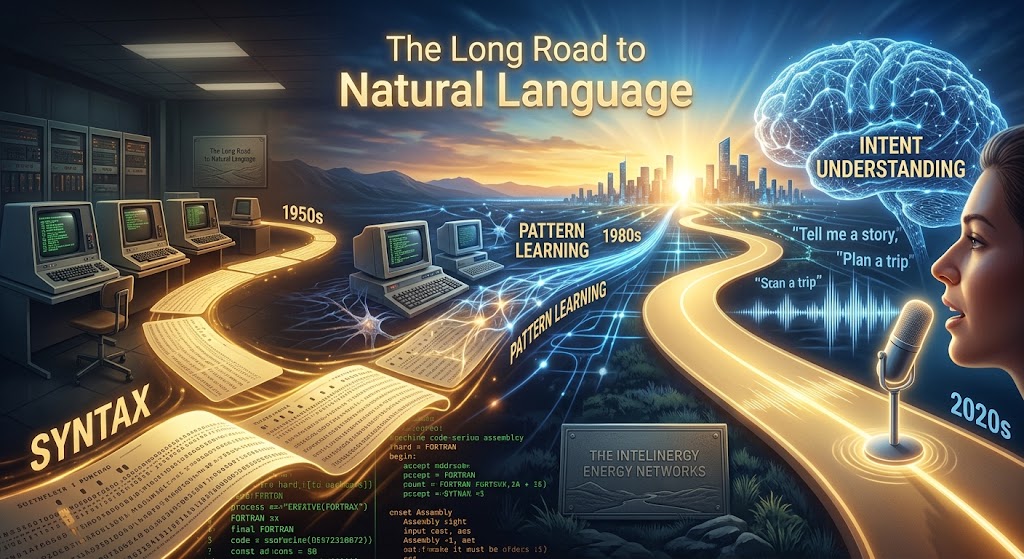
The original dream of computing was brilliantly simple: build a machine, tell it what to do, and let it do the work. As humans, our ultimate goal has always been to communicate with computers the same way we communicate with each other—using our natural, everyday language.
Yet, looking at the history of computer science, we arrived at this goal incredibly late. Instead of just talking to computers, we spent the last 70 years inventing thousands of complex programming languages.
This raises two massive philosophical questions:
- If the goal was always to give instructions, why couldn't we just use our natural language from the very beginning?
- Once we had compilers that translated our code into machine instructions, why didn't the machine just understand what the programmer wanted to do?
To answer these questions, we have to look at the history of Artificial Intelligence and the fundamental gap between "translating" and "understanding."
The Illusion of Natural Language: Why We Built the Tower of Babel
If we want a computer to do something, why not just tell it in English?
In the early days of computing, pioneers actually thought this would be easy. In 1951-1952, American mathematician Grace Hopper invented the A-0 System, widely considered the first compiler. Hopper believed programmers should be able to write code in English-like instructions rather than raw binary machine code.
But early researchers quickly hit a massive, seemingly unbreakable wall: ambiguity.
Human language is wildly imprecise and relies heavily on context. If you say, "I saw a man on a hill with a telescope," another human instantly uses common sense to know what you mean. A computer, however, freezes in confusion. Did you have the telescope? Did the man have the telescope? Was the telescope physically mounted on the hill?
Computers run on binary logic—1s and 0s. They require absolute, mathematical certainty. Early computers simply did not have the processing power or the architecture to understand human context.
Because we couldn't bring the computer up to our level of understanding, we had to meet it in the middle. We invented Programming Languages as a bridge. Languages like C, Java, and Python are "controlled human languages." We created hundreds of them because different tasks required different types of control. They were necessary compromises: human enough for us to read, but strict enough for a machine to execute without a single drop of ambiguity.
The Stubborn Compiler: Translation vs. Understanding
This brings up a fascinating second argument. Programming languages are designed to be run through a "compiler"—a program that translates human-readable code into raw machine code (binary).
If the compiler is already translating our code into the computer's native language, why didn't it understand what we wanted to do? We only recently got AI code suggestions, but shouldn't the machine have understood its own functions decades ago?
The answer lies in the difference between Syntax (the rules) and Semantics (the meaning).
Historically, a compiler was just a blind dictionary. If you type print("Hello World"), the compiler simply looks up the exact, predefined machine code required to push those pixels to a screen. Think of an old compiler like a person translating a book from Russian to English using a dictionary, but they don't actually speak Russian. They can swap the words out perfectly, but they have absolutely no idea what the story is about.
Good Old-Fashioned AI and the Logic Wall
Early AI—often called "Symbolic AI" or GOFAI (Good Old-Fashioned AI)—tried to solve this by hard-coding millions of logic rules.
At the famous Dartmouth Workshop in 1956 (the founding event of Artificial Intelligence), founders wildly underestimated the complexity of language, assuming a small group of scientists could figure out how to make machines use language and form abstractions in just a two-month summer study.
They did have early successes, such as SHRDLU, developed by Terry Winograd between 1968 and 1970. SHRDLU could converse in English and follow commands, but only within a severely restricted, hard-coded virtual "blocks world". Once you stepped outside those rigid rules, the illusion broke.
The realization hit hard: you cannot write a rigid mathematical rule for every possible human thought. The compiler knew how to execute the function flawlessly, but it had zero concept of why you were executing it. It lacked intent.
The Neural Network Shift: Finally Closing the Gap
It wasn't until the massive shift toward Deep Learning and Neural Networks in the 2010s that things fundamentally changed.
Instead of giving a computer a rigid dictionary or a set of hard-coded rules, scientists fed neural networks billions of examples of human code, books, and conversations. This allowed the machine to learn the patterns of intent on its own.
This is why Large Language Models (LLMs) today can give you accurate code suggestions or write entire programs from a simple English prompt. The machine finally stopped trying to translate words blindly. By processing massive amounts of data, it learned to predict your underlying goal.
A Timeline of Machine Understanding
| Era | Milestone | The "Language" Barrier |
|---|---|---|
| 1950s | The First Compilers | Grace Hopper's A-0 (1952) forces humans to adapt to the machine's strict rules. Intent is purely on the programmer. |
| 1956 | The Dartmouth Workshop | AI is officially born. Founders vastly underestimate the complexity of natural language, assuming it could be solved in a summer. |
| 1968–1970 | Symbolic AI & SHRDLU | AI can "understand" English, but only in tiny, hard-coded virtual environments. General human context proves too ambiguous. |
| 1980s | Moravec's Paradox | Researchers realize that high-level math is easy for computers, but a toddler's natural grasp of language and context is incredibly hard. |
| 2010s | The Deep Learning Boom | Transition from rigid rule-based logic to pattern recognition. Machines consume massive data to learn semantics (meaning) instead of strict syntax. |
| 2020s | LLMs & Natural Intent | The convergence of Compilers and AI. We finally speak natural language; the machine understands the intent and writes the syntax for us. |
Were We Late?
It feels like we are incredibly late to the original promise of computing. We spent decades forcing humans to think like machines—memorizing syntax, fighting with stubborn compilers, and learning dozens of rigid languages just to get a computer to perform basic tasks.
But in the grand timeline of technology, this 70-year detour was completely necessary. We couldn't build AI that understands natural language until we had immense computing power and mountains of digital data. And ironically, the only way we could build the internet, the data centers, and the processors required for modern AI was by using those rigid, inflexible programming languages first.
We weren't late; we were just building the foundation. And now, the original goal has finally been reached: the computer is learning to speak our language.